


发布时间: 2026/1/9

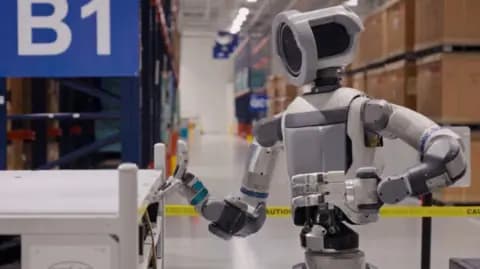
If you’ve been keeping an eye on the future of industrial work, you know humanoid robots are no longer just sci-fi fantasies. Hyundai Motor Group is leading the charge to bring this tech to factory floors, with plans to deploy Boston Dynamics’ Atlas humanoid robots across its global operations starting in 2028. This move puts Hyundai alongside a growing list of major companies racing to integrate humanoid robotics into daily workflows.
Hyundai’s 2028 Atlas Deployment Strategy
At this year’s Consumer Electronics Show (CES) in Las Vegas, Hyundai pulled back the curtain on its ambitious robotics plan, showcasing the Atlas robot developed by Boston Dynamics—a company in which Hyundai holds a majority stake, famous for its viral Spot robot dog. The South Korean automaker revealed it intends to roll out Atlas across all its global facilities, including its plant in Georgia, U.S., which made headlines in 2025 following a massive immigration raid.
Hyundai isn’t rushing this deployment; instead, the Atlas robots will gradually take on more tasks over time. The goal is to fully integrate the robots into the factory ecosystem, where they’ll work alongside human employees rather than replacing them entirely. This phased approach allows both workers and management to adapt to the new technology, ensuring a smooth transition for all involved. The company hasn’t shared initial deployment numbers or project costs, focusing instead on building a sustainable integration model.
Atlas’ Role in Modern Factories
Designed specifically for general industrial use, Atlas is built to collaborate with human workers and autonomously manage machinery. Hyundai emphasizes that these robots will fill critical roles that ease the burden on their human counterparts. For example, Atlas can handle repetitive, physically straining tasks that often lead to worker fatigue or injury, such as heavy lifting or prolonged assembly line work. Additionally, the robot can take on potentially dangerous jobs, like working with hazardous materials or in high-risk environments, reducing workplace accident risks.
Beyond immediate safety and efficiency gains, Hyundai views Atlas as a stepping stone to wider adoption of humanoid robotics in various industries. By proving the technology’s value in automotive manufacturing, the company hopes to pave the way for its use in other sectors, from logistics to construction. The robot’s ability to adapt to different tasks makes it a versatile tool for modern industrial needs.
Competitors Jumping on the Humanoid Robot Bandwagon
Hyundai isn’t alone in its push to use humanoid robots. Several other industry giants have already announced plans to integrate these machines into their operations. Amazon, the e-commerce leader, is exploring how humanoid robots can streamline its warehouse workflows, while Tesla has been heavily investing in its own Optimus robot, designed to handle tasks in its electric vehicle factories. Chinese car manufacturing giant BYD is also in the mix, joining the race to leverage this cutting-edge technology.
This widespread interest underscores the growing belief that humanoid robots will play a key role in the future of work. As companies compete to stay ahead in automation, we’re likely to see even more innovative uses for these machines in the coming years. The race to perfect humanoid robotics is heating up, with each company bringing its own unique approach to the table.
Context on Hyundai’s Georgia Plant Controversy
Hyundai’s mention of its Georgia plant in the U.S. brings up a significant event from 2025: a massive immigration raid that resulted in the arrest of hundreds of workers, including at least 300 South Korean citizens. The incident sparked outrage in South Korea, particularly over reports that workers had their legs shackled during the raid. South Korean President Lee Jae Myung and Hyundai’s CEO José Muñoz both warned that the raid could deter foreign investment in the U.S., raising concerns about the country’s business climate for international companies.
Thankfully, the situation was resolved later that month, when Washington and Seoul reached an agreement to release the detained workers. Former U.S. President Donald Trump publicly opposed the raid, stating that the U.S. had an understanding with global partners about bringing in experts to set up specialized facilities and train local workers. Muñoz later revealed that the White House had personally called him to apologize for the incident, a move that helped ease tensions between the two nations.
Addressing Worker Job Security Concerns
Naturally, news of widespread robot deployment raises questions about job security for human workers. At CES, Hyundai’s Vice Chair Jaehoon Chang directly addressed these concerns, acknowledging that it’s a valid worry for many. However, he emphasized that human workers will still be essential in the factory of the future. Workers will be needed to train the robots, oversee their operations, handle complex problem-solving tasks that robots can’t yet tackle, and provide the human touch that’s critical for many manufacturing processes.
Hyundai’s approach focuses on collaboration rather than replacement, ensuring that robots augment human capabilities instead of taking over entire roles. This balanced strategy is designed to maximize efficiency while preserving jobs and supporting worker well-being. The company believes that this human-robot partnership will create a safer, more productive work environment for everyone.
Hyundai’s Long-Term U.S. Investment Commitment
The Atlas deployment plan is part of a larger investment strategy Hyundai announced in 2025, when it pledged over $20 billion to expand its presence in the U.S. This investment supports efforts to boost manufacturing in the country, aligning with former President Trump’s goals to strengthen domestic production. The funds will go toward expanding car production facilities, investing in autonomous driving technology, and advancing artificial intelligence (AI) research and development.
This significant financial commitment highlights Hyundai’s long-term vision for the U.S. market, positioning the company as a key player in the future of American manufacturing and technology innovation. As the company moves forward with its robot deployment plans, it’s clear that Hyundai is betting big on the intersection of automation and human collaboration.